Blood Tests and Health Screening in Abuja: Your Options
If you're searching for a blood test in Abuja, you're probably weighing two things at once: which tests you need, and where you can get them done without losing a chunk of your day to the drive between districts. Both belong in the same decision, because in a city laid out the way Abuja is, getting to a lab is often as much of a factor as the test itself.
Most people in Abuja get a blood test for one of five reasons: a routine checkup, a specific symptom, a pre-employment or insurance requirement, antenatal care, or premarital genotype screening.
A routine checkup is the most common driver, someone who feels fine but wants a baseline reading on blood pressure, blood sugar, and cholesterol before anything goes wrong. Close behind is symptom-driven testing: fatigue, a recurring fever, unexplained weight change, or a doctor's visit that ends with a lab request to figure out what's causing it.
Pre-employment and insurance screening is its own category, usually a fixed checklist set by an employer rather than something the patient chose. Some of this screening is linked to NHIA (Nigeria's National Health Insurance Authority, which took over from the former NHIS), though what's covered depends on the specific scheme and employer, so it's worth confirming directly with your provider rather than assuming a fixed list applies. Antenatal blood work is standard through pregnancy, covering blood group, genotype, infectious disease screening, and general health markers. Premarital genotype testing has also become close to an expected step for couples in Nigeria, driven by how common the sickle cell trait is in the population, a point covered in more depth in our genotype test article below.
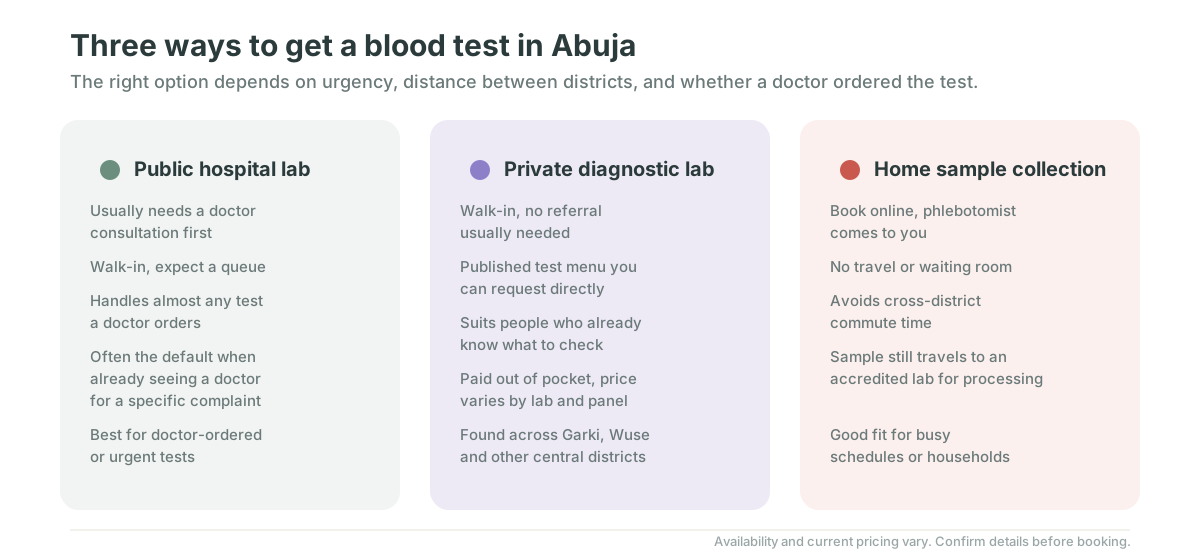
In Abuja, a blood test can be done at a public hospital laboratory, a private diagnostic lab, or through a home-sample-collection service that sends a phlebotomist to you.
General hospitals, both public and private, run their own labs and can handle almost any test a doctor orders, usually as part of a wider consultation. National Hospital Abuja is one widely known example of a public hospital offering this route, though it is far from the only one in the city. This tends to be the default option if you're already seeing a doctor for a specific complaint, since the same visit that produces a diagnosis can also produce the lab request.
Private diagnostic labs operate independently of any hospital and specialise purely in testing. They typically publish a menu of tests you can walk in and request directly, without needing a doctor's referral first, which suits people who already know what they want checked and don't need a consultation attached. You'll find these across the central districts, Garki, Wuse, and along the wider Central Business District corridor, among other places.
Home-sample-collection services are the newer option: a trained phlebotomist comes to your home or office, draws the sample there, and the specimen travels to an accredited lab for processing while you carry on with your day. BetterHealth Africa operates in this category in Abuja. The trade-off is straightforward: you give up walking into a physical lab, and in exchange you get the test done wherever you already are.
Abuja's wide, spread-out layout across districts like Garki, Wuse, Maitama, Gwarinpa and Lugbe means a round trip to a lab can easily eat a half day once distance and waiting are counted, which is why home sample collection is a genuine option here, not just a convenience.
This isn't a dramatic claim, just an honest one for anyone who has made the trip. Abuja was built as a planned city with wide roads and clearly separated districts, which makes it feel orderly on a map, but it also means the distance between where you live and where a specific lab sits can be considerable. Someone living in Lugbe or Gwarinpa who needs a test done at a facility in Garki or Wuse is looking at a real commute each way, on top of the queue once they arrive. For a working parent, someone caring for an elderly relative, or a patient who is unwell enough that travel itself is a burden, that time cost adds up fast.
Home sample collection doesn't remove every step (the specimen still needs to reach an accredited lab for processing), but it does remove the travel and waiting-room portion entirely. That's the specific problem it solves, and in a city built across this much distance, it's a legitimate reason to consider it rather than a marketing flourish.
A standard full checkup panel in Abuja commonly includes a full blood count, fasting blood sugar, a lipid profile, genotype, blood group, hepatitis B, and HIV screening.
- Full blood count (FBC): checks red cells, white cells, and platelets, and is a starting point for spotting anaemia or infection.
- Fasting blood sugar: screens for prediabetes and diabetes, usually alongside or instead of HbA1c.
- Lipid profile: measures cholesterol and triglycerides, both markers of heart and stroke risk.
- Genotype: identifies your haemoglobin type (AA, AS, SS and related variants), most relevant before marriage or pregnancy.
- Blood group: your ABO type and Rhesus factor, needed for transfusions and relevant in pregnancy.
- Hepatitis B: a common ask for pre-employment screening, antenatal visits, and premarital panels.
- HIV test: routine, confidential, and worth repeating periodically rather than treating as a one-time check.
Not every visit needs every item on that list. A pre-employment screen might stop at a handful of these, while an antenatal panel adds more on top. A doctor or an accredited lab can tell you which subset applies to your specific situation, and it's worth asking rather than assuming a longer list is automatically better.
Abuja's disease pattern makes hypertension, diabetes, typhoid, malaria, and sickle cell status the conditions most worth testing for, alongside anything a doctor recommends for your own symptoms.
Hypertension and diabetes are both common in urban Nigeria and both tend to cause no symptoms until they've already done damage, which is exactly why they belong in a routine screen rather than waiting for a reason to check. Typhoid and malaria remain common causes of fever in Abuja and across Nigeria more broadly, and a lab test is the only reliable way to tell them apart from each other or from a viral illness, since the symptoms overlap heavily.
Sickle cell and genotype status carries particular weight in Nigeria. Roughly one in four Nigerians carries the sickle cell trait (AS), and Nigeria has the highest number of children born with sickle cell disease of any country, a fact tied directly to how widespread the trait is across the population. That's the reason genotype testing has become a standard part of premarital and antenatal screening here rather than an optional extra.
Read more: what AA, AS and SS mean, and what genotype compatibility means for a couple
Premarital screening: the tests every couple should do before marriage
Choosing where to test in Abuja comes down to three things: is the lab accredited, is your result handled privately, and will you get a clear answer on when to expect it.
Accreditation matters most for results that carry real consequences, genotype, HIV, hepatitis B, anything feeding into a medical or life decision. An accredited lab follows quality standards that an informal testing stall or an unverified kit cannot guarantee, and for a test like genotype, only proper laboratory methods (haemoglobin electrophoresis or HPLC) give a result you can rely on.
Privacy matters too, particularly for HIV and hepatitis testing, where confidentiality of the result is part of what makes people willing to test at all. And before you book, it's worth asking plainly how the lab or service expects to reach you with results and roughly what to expect, rather than assuming a specific timeline. Turnaround varies by test and by lab, and a service that gives you a straight answer up front is easier to plan around than one that doesn't.
See the tests BetterHealth Africa offers with home sample collection
View BetterHealth Africa test pricing
Frequently asked questions
Where can I get a blood test in Abuja?+
You have three main options: a public hospital laboratory, a private diagnostic lab, or a home-sample-collection service that sends a phlebotomist to draw your sample wherever you are. Which one suits you depends on whether you already need a doctor's consultation, how specific your test request is, and how much you want to avoid the drive across districts.
Can someone collect my blood sample at home in Abuja?+
Yes. Home-sample-collection services, including BetterHealth Africa, send a trained phlebotomist to your home or office to draw the sample, which then travels to an accredited lab for processing. This is a genuine option worth considering in Abuja given how much time a round trip between districts like Lugbe, Gwarinpa, Garki and Wuse can cost.
How long do blood test results generally take?+
It depends on the specific test and the lab processing it. Some tests, like a full blood count or blood sugar, are often processed same-day or next-day, while others take longer. Ask the lab or service directly what to expect for your specific test rather than assuming a fixed turnaround.
What's included in a standard full checkup in Abuja?+
A common baseline includes a full blood count, fasting blood sugar, a lipid profile, genotype, blood group, hepatitis B, and HIV screening. Not every checkup needs all of these, and a doctor or lab can help you narrow the list to what's relevant for your age, symptoms, and reason for testing.
Do I need to fast before a blood test?+
It depends on the test. Fasting blood sugar and a lipid profile usually require 8 to 12 hours without food, while tests like full blood count, genotype, blood group, and most infectious disease screens (HIV, hepatitis B) don't need fasting at all. Check with your lab or provider ahead of time so you don't fast unnecessarily or show up unprepared.
Is home blood testing available in Abuja?+
Yes. BetterHealth Africa offers home sample collection in Abuja, where a trained phlebotomist visits your home or office, draws the sample, and it is transported to an accredited lab for processing. This avoids travel and waiting-room time for routine tests, which matters given how spread out the city's districts are.
This article is general health education, not medical advice. It is not a substitute for diagnosis or treatment by a qualified healthcare professional. Test availability, services and prices vary by lab and can change, so confirm current details with the specific lab or service before booking, and always discuss your results with your doctor.