Tuberculosis Testing: Sputum, Skin, and Blood Tests Explained
Tuberculosis remains one of the leading infectious causes of death across sub-Saharan Africa, according to the World Health Organization, and it is also one of the most misunderstood diseases when it comes to testing. There is no single "TB test". There is a sputum test that confirms active disease, a skin or blood test that checks whether the body has ever encountered the bacteria, and an X-ray that supports a diagnosis without confirming it on its own. Knowing which test does what matters, because a positive result on one of them does not mean the same thing as a positive result on another.
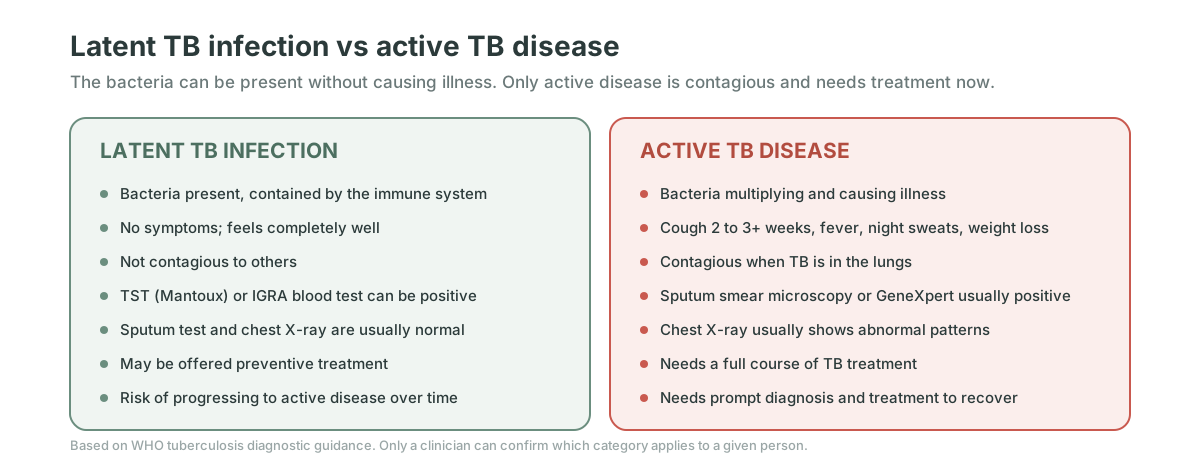
Latent TB infection means the bacteria are present but contained by the immune system, while active TB disease means the bacteria are multiplying and making a person sick
This is the single most important distinction in tuberculosis, and it trips people up constantly. A person can carry TB bacteria in their body for years, even a lifetime, without ever feeling ill, without spreading it to anyone, and without needing urgent treatment. That state is called latent TB infection: the immune system has walled the bacteria off, and they sit dormant rather than causing damage.
Active TB disease is different. It happens when the bacteria break free of that containment and start multiplying, most often in the lungs. At that point a person develops symptoms, can pass the infection to others through coughing, and needs a full course of treatment. Only a small share of people with latent infection ever progress to active disease, but certain conditions, HIV chief among them, raise that risk substantially, which is why the distinction is not just academic. It decides whether someone needs urgent treatment and precautions, or simply monitoring.
The classic symptoms of active pulmonary TB are a cough lasting more than two to three weeks, night sweats, unexplained weight loss and fever, though these overlap with many other conditions and are not something to self-diagnose
A cough that will not go away after two or three weeks is the symptom doctors across Africa are trained to take seriously as a possible sign of TB, especially when it comes with any of the following:
- Night sweats that soak through clothing or bedding
- Unexplained weight loss over weeks or months
- Low-grade fever that persists, often worse in the evening
- Fatigue and general loss of appetite
- Coughing up blood or blood-streaked sputum, in more advanced cases
None of these symptoms is unique to tuberculosis. A persistent cough can come from asthma, chronic bronchitis, a lingering chest infection, or several other conditions entirely unrelated to TB. Night sweats and weight loss show up in other infections too. The point of this list is not to hand anyone a self-diagnosis. It is to flag when a cough has gone on long enough, or come with enough other symptoms, that it needs a doctor's evaluation rather than another round of over-the-counter cough syrup.
Sputum smear microscopy and GeneXpert molecular testing are the standard diagnostic tests for active pulmonary TB, and both examine a sample of coughed-up sputum rather than blood
When a doctor suspects active pulmonary TB, the next step is a sputum sample, mucus coughed up from the lungs, not saliva. Sputum smear microscopy is the older and simpler of the two main tests: a lab technician stains the sample and looks under a microscope for acid-fast bacilli, the rod-shaped bacteria that cause TB. It is widely available, inexpensive, and fast, but it misses a meaningful share of cases, particularly milder ones, and usually needs more than one sample to be reliable.
GeneXpert, also known as Xpert MTB/RIF, is a molecular test that looks for the bacteria's genetic material directly rather than relying on what is visible under a microscope. It is markedly more sensitive than smear microscopy, delivers a result in about two hours, and does something smear microscopy cannot: it checks in the same run whether the bacteria carry resistance to rifampicin, one of the core first-line TB drugs. That resistance flag matters enormously, because it tells a clinician early whether standard treatment is likely to work or whether drug-resistant TB needs a different regimen. The World Health Organization recommends GeneXpert as an initial test wherever it is available, precisely because of this speed and the resistance information it provides.
The tuberculin skin test (TST, or Mantoux test) and interferon-gamma release assays (IGRA) detect whether a person has ever been infected with TB bacteria, not whether they currently have active disease
The TST works by injecting a small amount of tuberculin protein under the skin of the forearm. A trained health worker then checks the injection site 48 to 72 hours later, measuring any raised, hardened area that has formed. That reaction means the immune system recognises TB proteins, which points to infection at some point, current or past, latent or active. It does not, by itself, distinguish between the two, and it can also read as a false positive in someone who received the BCG vaccine, which is common across much of Africa.
IGRA is a newer alternative that uses a blood sample rather than a skin injection. It measures how strongly a person's immune cells release interferon-gamma when exposed to TB-specific proteins in the lab. Its main practical advantage over the TST is that it is not thrown off by BCG vaccination, and it only requires one visit rather than a return trip 48 to 72 hours later to have the skin reaction read. Neither test tells a clinician whether someone has active disease; a positive result on either simply means further evaluation, usually including a sputum test and a clinical assessment, is needed to work out which category a person falls into.
A chest X-ray can support a TB diagnosis by showing lung patterns typical of the disease, but it is a supportive tool used alongside sputum testing, not a standalone diagnostic test
Chest X-rays are useful in the TB work-up for a few reasons. They can pick up patterns, such as cavities or shadowing in the upper lobes of the lungs, that raise suspicion of TB and prompt a sputum test where one might not otherwise have been ordered. They can also help a clinician judge how extensive the disease is, and rule out other lung conditions that might explain a cough. What an X-ray cannot do is confirm TB on its own, since several other lung diseases can produce similar-looking images. That is why it is used as a triage and supporting tool alongside bacteriological testing, not a replacement for it.
HIV is the strongest known risk factor for progression from latent TB infection to active TB disease, which is why co-testing for both is standard practice across high-burden African health systems
The link between TB and HIV is one of the most consistently documented facts in African public health. The World Health Organization reports that HIV weakens the immune system's ability to keep TB bacteria contained, which sharply raises the chance that a latent infection progresses to active disease. TB, in turn, is one of the leading causes of death among people living with HIV on the continent. Because the two conditions feed into each other so directly, WHO guidance in high-burden settings calls for offering an HIV test to anyone being evaluated for TB, and TB screening to anyone newly diagnosed with HIV. Neither test stands alone in these settings; each one is a prompt to check for the other.
HIV testing explained: window periods, test types, and what a reactive result means
This co-testing relationship is also a useful reminder that a persistent cough or unexplained fever is worth investigating properly rather than guessing at. TB is not the only major infectious disease across the continent with a symptom picture worth understanding on its own terms; malaria, for instance, presents quite differently, typically as an acute fever rather than a weeks-long cough, but it is another condition where a proper test, not a guess, is what actually confirms what is going on.
Another major infectious disease test explained: malaria RDT vs blood film
A confirmed diagnosis of active TB is not the end of the story, and it helps to know roughly what comes next. Standard first-line treatment is a multidrug course, typically lasting around six months, and the drugs work together precisely because TB bacteria can develop resistance to any single medicine used on its own. Many national TB programmes across Africa support patients through directly observed therapy, where a health worker confirms each dose is taken, because finishing the full course, not just feeling better partway through, is what actually clears the infection and prevents drug-resistant TB from developing.
Anyone with a cough lasting more than two to three weeks, unexplained weight loss, night sweats, or known contact with a person who has active TB should see a doctor for proper evaluation rather than waiting it out
- Do not try to interpret your own symptoms as a TB diagnosis. See a doctor if a cough has lasted more than two to three weeks, especially alongside night sweats, weight loss or fever.
- If you have had close contact with someone diagnosed with active TB, mention that clearly when you seek care, since it changes how quickly testing should happen.
- If you are living with HIV, ask your clinic about routine TB screening, and if you are being evaluated for TB, ask about an HIV test at the same time.
- Expect a sputum test (smear microscopy or GeneXpert) as the way active pulmonary TB gets confirmed, not a skin or blood test alone.
- If a skin or blood test for TB infection comes back positive, understand that it points to infection, not automatically to active, contagious disease. Your clinician will assess which one applies to you.
- Follow the full treatment course exactly as prescribed if you are diagnosed with active TB. Stopping early is one of the main drivers of drug-resistant TB.
See the infectious disease and general health panels BetterHealth Africa tests
Check BetterHealth Africa test pricing
Frequently asked questions
What is the difference between latent TB infection and active TB disease?+
Latent TB infection means TB bacteria are present in the body but contained by the immune system: no symptoms, not contagious, and often no treatment needed beyond monitoring or, in some cases, preventive therapy. Active TB disease means the bacteria are multiplying and causing illness: symptoms are present, pulmonary TB is contagious, and a full course of treatment is required. A skin or blood test alone cannot tell the two apart; that usually needs a sputum test and clinical evaluation.
Does BetterHealth Africa test for tuberculosis?+
No. TB diagnostic testing, including sputum smear microscopy, GeneXpert and chest X-ray, is carried out through hospital or public TB-programme channels, since diagnosing and managing TB requires clinical evaluation, specific laboratory capacity and, in many countries, notification to national TB control programmes. BetterHealth Africa's home testing covers routine screening and common conditions, including HIV testing, which is relevant given how closely TB and HIV are linked. If you suspect TB, a doctor or public health facility can arrange the right testing directly.
What is GeneXpert and how is it different from sputum smear microscopy?+
Both look for TB in a sputum sample, but they work differently. Smear microscopy stains the sample and checks it under a microscope for the bacteria. GeneXpert is a molecular test that detects the bacteria's genetic material directly, is more sensitive, returns a result in about two hours, and also checks for resistance to rifampicin, a core first-line TB drug, in the same test run.
Can a chest X-ray diagnose TB on its own?+
No. A chest X-ray can show patterns, such as cavities or shadowing, that raise suspicion of TB and support a diagnosis alongside other tests, but several other lung conditions can look similar on an X-ray. It is used as a supportive tool together with a sputum test, not as a standalone diagnosis.
Why are people with HIV tested for TB more often?+
The World Health Organization identifies HIV as the strongest known risk factor for progressing from latent TB infection to active TB disease, because HIV weakens the immune system's ability to keep TB bacteria contained. TB is also a leading cause of death among people living with HIV in Africa. Because of this, TB screening is a routine part of HIV care, and an HIV test is routinely offered to anyone being evaluated for TB, in high-burden settings across the continent.
If my TB skin test or IGRA blood test is positive, do I have active TB?+
Not necessarily. Both tests detect whether the immune system has ever encountered TB bacteria, which includes latent infection as well as active disease. A positive result means further evaluation, usually a sputum test and a clinical assessment for symptoms, is needed to work out whether you have latent infection or active disease. Only that follow-up evaluation can tell the two apart.
This article is general health education, not medical advice. It is not a substitute for diagnosis or treatment by a qualified healthcare professional. If you have a persistent cough, unexplained weight loss, night sweats, or have been in contact with someone diagnosed with active TB, see a doctor or public health facility for proper evaluation rather than self-diagnosing from this article.