Perimenopause and Menopause Testing: What an FSH Test Can (and Can't) Tell You
Periods that used to arrive like clockwork start skipping weeks, then arriving twice in one month. Sleep gets thinner. A hot flush lands in the middle of a meeting. For a lot of women in their 40s, this is the point where they go looking for a perimenopause test, hoping a single number will confirm what their body already seems to be telling them.
FSH is a useful hormone to measure, but during perimenopause specifically it can be one of the least reliable single numbers on a blood test. This article walks through what perimenopause and menopause are, which symptoms usually come first, what FSH and estradiol show, why one reading can mislead, where pharmacy FSH test kits fit, and when a doctor will order hormone testing.
Menopause is confirmed after 12 consecutive months without a period, and perimenopause is the transition that leads up to it and can last several years.
Menopause has one clean clinical definition: 12 consecutive months with no menstrual period, with no other cause explaining the gap. Most women reach it somewhere between 45 and 55, with the average landing around age 51 in most populations studied. That range is a general guide, not a precise prediction for any one woman, since genetics, smoking, surgery and other factors can shift it earlier or later.
Perimenopause is everything that happens before that final period. Ovarian function does not switch off overnight. It winds down over months to several years, and during that stretch estrogen and progesterone rise and fall unevenly from one cycle to the next. Periods become irregular well before they stop completely, and this uneven, unpredictable phase is what most women mean when they say they think they are starting menopause.
Irregular periods, hot flushes, night sweats, disrupted sleep and mood changes are usually enough on their own for a doctor to recognise perimenopause in a woman of typical age.
For most women over 45, the symptom pattern does more diagnostic work than any lab result. A clinician who hears about irregular cycles alongside hot flushes and sleep trouble in a woman in her late 40s already has a strong working picture before a single vial of blood is drawn.
- Periods that become irregular in timing, length or flow
- Hot flushes or hot flashes, often worse at night
- Night sweats that disrupt sleep
- New or worsened sleep disturbance, separate from night sweats
- Mood changes, including irritability, low mood or anxiety
- Vaginal dryness or discomfort
- Reduced fertility, even though pregnancy is still possible until periods fully stop
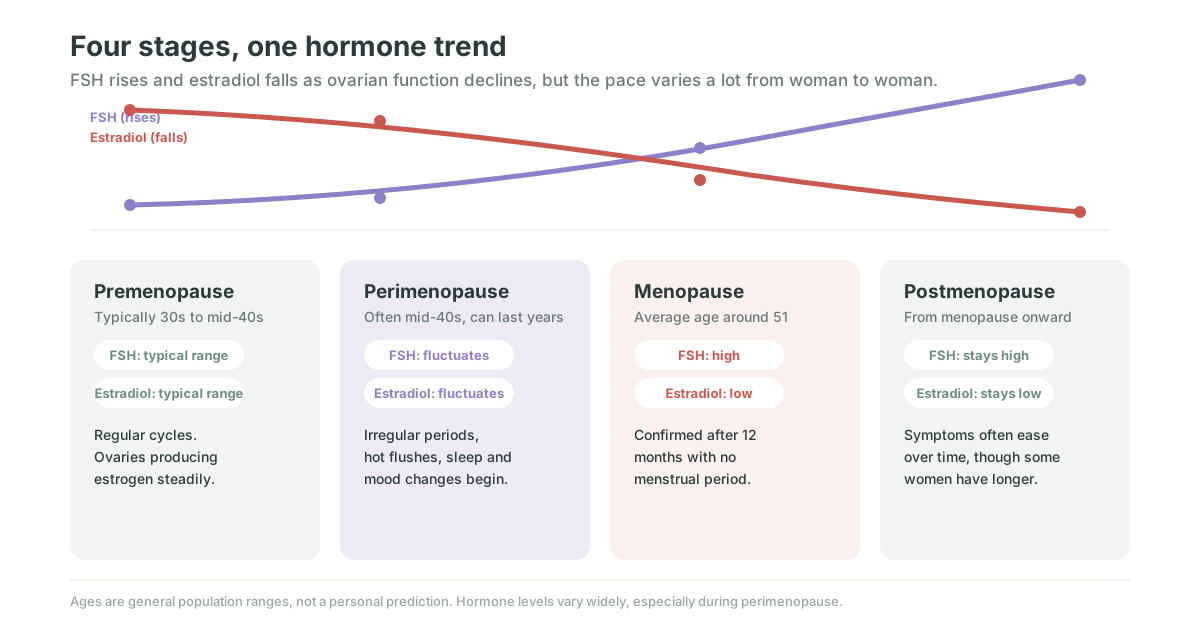
FSH rises and estradiol falls as ovarian function declines, which is exactly the pattern a hormone test is trying to catch.
Follicle-stimulating hormone, or FSH, comes from the pituitary gland and its job is to prompt the ovaries to mature an egg each cycle. When the ovaries respond well, they produce estrogen, mainly in the form of estradiol, and that estrogen signals back to the pituitary to keep FSH in check. As the ovaries have fewer follicles left to recruit, they produce less estradiol, and the pituitary responds by raising FSH to try to compensate. A high FSH paired with a low estradiol is the pattern that supports a diagnosis of menopause once periods have already stopped.
A single FSH test taken during perimenopause can read normal one day and elevated the next, so one result on its own is not a reliable way to diagnose the transition.
This is the part that trips up most people searching for a perimenopause test. During perimenopause, the ovaries have not shut down, they are working erratically. Some cycles still produce a normal amount of estrogen, and in those cycles FSH can sit comfortably in the normal range. Other cycles produce very little, and FSH spikes. Test on the wrong day and you get a result that does not match how you actually feel, or does not match the result you might get testing again a few weeks later.
One FSH reading is not the final word
A normal FSH result does not rule out perimenopause, and a high one taken during perimenopause does not confirm menopause on its own. Levels swing from cycle to cycle and even day to day at this stage of life, which is why a single test, taken alone, should not be treated as a diagnosis. A doctor typically weighs it alongside your age, your symptoms and your period pattern, and may repeat it if the picture is unclear.
Over-the-counter FSH test kits sold at pharmacies measure the same hormone as a lab blood test, and they carry the same single-reading limitation.
Pharmacy shelves in South Africa and elsewhere carry urine-based FSH test kits marketed for women who want a quick read at home. These kits are checking for the same hormone a lab measures in blood, and the biology does not change because the test is done at home. A raised result from a pharmacy home test kit is a data point worth mentioning to a doctor, not an answer in itself, especially if it was taken during a phase of irregular cycles. Treat it the same way you would treat a single lab FSH result: useful context, not a verdict.
NAMS (The Menopause Society) and NICE both generally advise against routine hormone testing in women over 45 with typical symptoms, and reserve it for younger women or an unclear clinical picture.
Because a single hormone reading is so easily thrown off during perimenopause, major bodies including NAMS in the United States and NICE in the United Kingdom generally recommend that women over 45 with a typical symptom pattern be diagnosed on history and symptoms alone, without routine FSH testing. Hormone testing earns its place in a narrower set of situations instead.
- Women under 40 to 45 with menopause-like symptoms, to help rule in or rule out premature ovarian insufficiency
- Women who have had a hysterectomy without removal of the ovaries, where periods can no longer be tracked as a marker
- Cases where the clinical picture is unclear, or another condition needs to be excluded first
In other words, hormone testing is most valuable precisely when age and symptoms alone are not enough to tell the story, not as a routine confirmation for every woman in her late 40s with classic symptoms.
Fatigue, mood changes and irregular cycles can also point to a thyroid problem, which is why doctors usually weigh more than one explanation before settling on perimenopause.
Thyroid disorders share a striking number of symptoms with perimenopause: fatigue, mood changes, weight shifts and irregular periods can all show up in both. Thyroid disease is also more common in women, and its onset often overlaps with the same 40s and 50s window when perimenopause typically begins. A doctor who suspects perimenopause may still check thyroid function, since treating an underlying thyroid problem can resolve symptoms that hormone therapy for menopause would not touch.
Thyroid function and TSH: what your result is telling you
Low vitamin D is another common, easily overlooked contributor to fatigue and low mood at this life stage, and it is worth ruling out alongside a hormone panel rather than assuming perimenopause explains everything on its own.
Vitamin D deficiency: symptoms, causes and what your result means
Hormone replacement therapy and non-hormonal options can both ease perimenopause and menopause symptoms, and choosing between them is a decision made with a doctor.
Hormone replacement therapy, usually called HRT, works well for many women and can meaningfully ease hot flushes, night sweats and vaginal dryness. It also carries considerations that depend on personal and family health history, including cardiovascular and cancer risk factors, which is exactly why it is a decision made with a doctor rather than a product picked off a shelf. Non-hormonal options exist too, from lifestyle changes to certain medications originally developed for other conditions, and a doctor can walk through what fits your symptoms and your health history.
BetterHealth Africa's hormone panel tests FSH alongside LH, estradiol, progesterone, DHEA-sulfate and SHBG, which gives a fuller picture than checking FSH alone.
Because no single hormone tells the whole story, a useful hormone panel looks at several markers together rather than FSH in isolation. BetterHealth Africa's hormone panel covers FSH, LH, estradiol, testosterone, progesterone, DHEA-sulfate, SHBG and AMH, drawn from a home blood-draw appointment rather than a clinic queue. Many medical aid schemes in South Africa offer some cover for hormone testing as part of a broader consultation, though this varies by plan and by scheme, so it is worth checking your own benefits before booking.
See the full hormone panel BetterHealth Africa tests
- Track your symptoms and period pattern for a few months. This history is often more useful to a doctor than a single hormone test.
- If you are over 45 with typical symptoms, expect your doctor to lean on symptoms and age first, not routine hormone testing.
- If you are under 40 to 45, had a hysterectomy without ovary removal, or your picture is unclear, ask your doctor whether hormone testing is appropriate for you.
- If a pharmacy FSH kit or a lab result comes back raised, discuss it with a doctor rather than treating it as a final answer.
- Ask your doctor about thyroid testing if fatigue, mood change or irregular cycles are prominent, since the symptom overlap is real.
- If symptoms are affecting your daily life, ask about both hormonal and non-hormonal options rather than assuming you have to just push through.
View BetterHealth Africa test pricing
Frequently asked questions
Does an at-home FSH test kit actually work for diagnosing menopause?+
It measures the right hormone, but a single reading has the same limitation as a single lab test: during perimenopause, FSH can swing from normal to high across different cycles, so one home test result is not diagnostic on its own. A raised result is worth discussing with a doctor rather than treating as a final answer.
What age does perimenopause usually start?+
Perimenopause most often begins in the mid-to-late 40s, though it can start earlier or later for some women. It typically lasts a few years before periods stop completely, and menopause itself is confirmed only after 12 consecutive months without a period, usually between ages 45 and 55.
Can you test for menopause at home?+
You can measure FSH at home with a pharmacy urine test kit, and a persistently high result alongside 12 months without a period is consistent with menopause. But menopause is really confirmed by that 12-month gap in your period history, not by a single hormone reading, especially if you are still in the irregular perimenopausal phase.
Why does one FSH test result vary from day to day?+
During perimenopause, the ovaries are still working, just erratically. Some cycles still produce a normal amount of estrogen, which keeps FSH in the normal range, while other cycles produce little estrogen, which pushes FSH higher. That inconsistency is exactly why one test is not considered reliable for diagnosing perimenopause on its own.
What actually helps with perimenopause and menopause symptoms?+
Options range from lifestyle changes to hormone replacement therapy to non-hormonal medications, and the right fit depends on your symptoms and your personal and family health history. A doctor can walk through what suits your situation rather than a one-size-fits-all recommendation.
Is a menopause test the same thing as an FSH test?+
Often, yes, an FSH test is the hormone test most commonly meant by the term menopause test, sometimes paired with estradiol. But for women over 45 with typical symptoms, most guidelines say a clinical diagnosis based on age and symptoms is enough, and hormone testing adds the most value in younger women or unclear cases.
This article is general health education, not medical advice. It is not a substitute for diagnosis or treatment by a qualified healthcare professional. Hormone reference ranges and the value of testing depend on your age, symptoms and individual history. Always discuss your own results and symptoms with your doctor.