Malaria Testing: RDT vs Blood Film, and How to Read the Result
Malaria is the most common reason for a fever work-up across sub-Saharan Africa, and it is also one of the most over-diagnosed by symptoms alone. Fever, chills, headache and body aches can mean malaria, but they can just as easily mean typhoid, a viral infection, or something else entirely. That is why testing, not guessing, is how malaria gets confirmed.
The two ways malaria is tested: RDT vs blood film
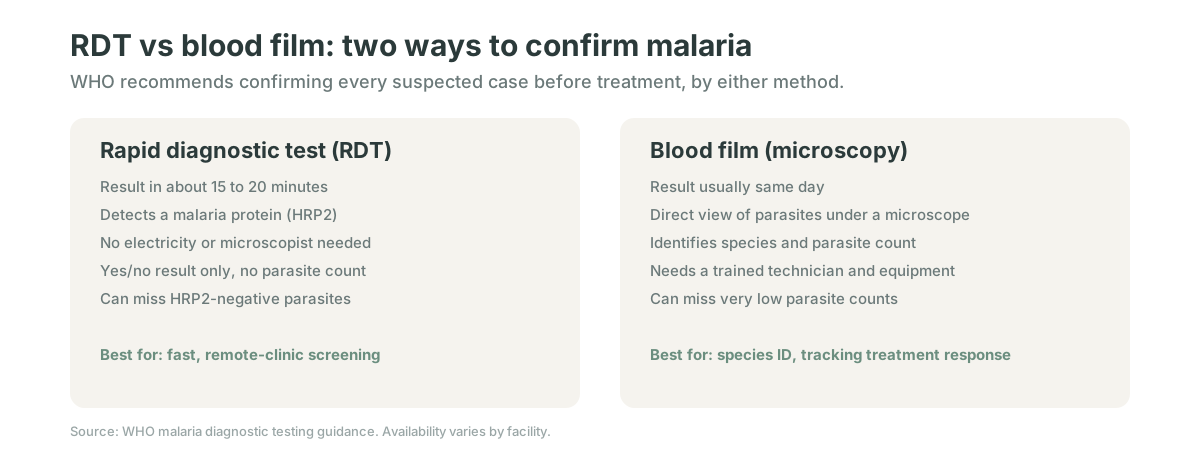
Malaria is confirmed with one of two tests, a rapid diagnostic test (RDT) or microscopy of a blood film, and the World Health Organization recommends confirming every suspected case before treatment.
Both tests use a small blood sample, usually from a finger prick. An RDT is a quick strip test you can get a result from in minutes, similar in spirit to a pregnancy test. A blood film means a laboratory technician smears your blood on a glass slide, stains it, and examines it under a microscope. Each has a different strength, which is why some situations call for one over the other.
Rapid diagnostic tests (RDT): how they work and their limits
An RDT detects malaria proteins in a finger-prick blood sample and gives a result in about 15 to 20 minutes, but it does not tell you how many parasites are present.
Most RDTs used in Africa detect a protein called HRP2, produced specifically by Plasmodium falciparum, the parasite species responsible for the large majority of malaria cases and nearly all malaria deaths on the continent. RDTs are fast, need no electricity or trained microscopist, and work well in clinics and pharmacies far from a laboratory. The trade-off is that an RDT gives a yes-or-no answer. It cannot tell you the parasite density, and in a small but real number of cases the parasite itself has lost the gene for the HRP2 protein, which can produce a false negative in a truly infected person.
Blood film (microscopy): the gold standard, and what parasite count means
Microscopy remains the reference standard because a trained technician can see the parasites directly, count how many are present, and identify the species.
A thick blood film is used to spot parasites when they are present; a thin blood film, spread more finely, lets the technician identify the exact Plasmodium species and estimate parasitaemia, the percentage of red blood cells infected, or the parasite count per microlitre of blood. This extra detail matters for treatment decisions and for tracking whether an infection is responding to treatment, which is something an RDT alone cannot show.
Why a negative test does not always rule out malaria
A single negative test does not always rule out malaria, especially early in infection when parasite levels are low or when a parasite has lost the protein an RDT is built to detect.
- Very early infection, when parasite numbers are still too low for either test to detect reliably
- HRP2 gene deletions in the parasite, which have been documented in several African countries and cause a false-negative RDT despite genuine infection
- A less experienced reader missing a low parasite count on a blood film
- Recent antimalarial use, which can suppress parasite numbers below a test's detection threshold
Persistent symptoms after a negative test deserve a second look
If fever and symptoms continue after a negative malaria test, especially in a high-transmission area, ask about a repeat test, a different test type, or microscopy if only an RDT was used the first time. WHO advises against ruling malaria out on a single negative RDT when clinical suspicion stays high.
Malaria species and why P. falciparum matters most in Africa
Plasmodium falciparum causes the large majority of malaria infections and nearly all malaria deaths in sub-Saharan Africa.
There are five Plasmodium species that infect humans, but P. falciparum dominates in Africa and is the species most capable of causing severe, rapidly progressing disease, including cerebral malaria and severe anaemia. This is part of why testing matters so much here specifically: a delay in confirming and treating falciparum malaria carries more risk than the same delay would with the milder species more common in some other regions.
Malaria vs typhoid: why fever often gets tested for both
Malaria and typhoid cause a very similar early fever, which is why clinicians across West and East Africa often test for both rather than assuming one.
Both illnesses can present with fever, headache, abdominal discomfort, and general malaise in the first several days, and it is common for someone to be treated for malaria based on symptoms alone when the actual cause is typhoid, or the reverse. Testing for both when a fever does not have an obvious source avoids weeks of the wrong treatment while the real infection continues.
Typhoid and the Widal test: what a positive result really means
What to do with your malaria result
- Get tested before starting antimalarial treatment. WHO recommends confirming malaria with an RDT or blood film rather than treating on symptoms alone.
- If you get an RDT and symptoms do not improve within 24 to 48 hours, ask about a repeat test or microscopy, particularly if the first test was negative.
- If a blood film is used, ask for the parasite count or parasitaemia percentage, not just a positive or negative result, since it helps guide how urgently treatment is needed.
- Complete the full course of any antimalarial medication prescribed, even once you feel better, to avoid relapse and drug resistance.
- If fever persists after malaria treatment or after a negative malaria test, ask about a typhoid test as well, since the two conditions overlap heavily in symptoms.
- Seek urgent care for warning signs of severe malaria: confusion, repeated vomiting, difficulty breathing, or a seizure.
See the infectious disease panel BetterHealth Africa tests
View BetterHealth Africa test pricing
Frequently asked questions
Which malaria test is more accurate, RDT or blood film?+
Neither is universally more accurate. RDTs are fast and convenient but give only a yes-or-no answer and can occasionally miss parasites that have lost the detected protein. Microscopy, done well by an experienced technician, can detect lower parasite counts and identify species and density, but it takes longer and depends on the skill of the reader. Many clinics use RDT first and confirm with microscopy when the picture is unclear.
Can you have malaria with a negative test?+
It is uncommon but possible, particularly very early in infection, after recent antimalarial use, or in the small number of cases where the parasite lacks the protein an RDT detects. If symptoms persist after a negative result, a repeat test or a different test type is reasonable.
How long does it take to get a malaria test result?+
An RDT typically gives a result in about 15 to 20 minutes. A blood film usually takes longer, often same day, depending on how busy the laboratory is and whether the sample needs to be sent elsewhere.
Do I need to fast before a malaria test?+
No. A malaria test does not require fasting and can be done at any time, including during a fever, since a blood sample is all that is needed.
This article is general health education, not medical advice. It is not a substitute for diagnosis or treatment by a qualified healthcare professional. Malaria can be a medical emergency, especially in children and pregnant women. Seek urgent medical care for high fever, confusion, repeated vomiting, or difficulty breathing, and always confirm a suspected malaria infection with a qualified healthcare provider.