Blood Tests and Health Screening in Ibadan: Your Options
If you live in Ibadan and need a blood test, there is more than one route to a result. You can join the queue at a public teaching hospital laboratory, walk into a private pathology lab, or book a home blood draw and have a phlebotomist come to you instead. Each route trades off differently on cost, speed, and how much of your day it takes, and the right one usually depends on why you are testing in the first place.
This guide walks through all three: what a typical visit looks like, how to prepare, and how to decide which fits your situation. It does not point you to one specific facility or quote a fixed naira price, since both vary by lab and change over time. For BetterHealth Africa's current test menu and pricing, the links further down take you there directly.
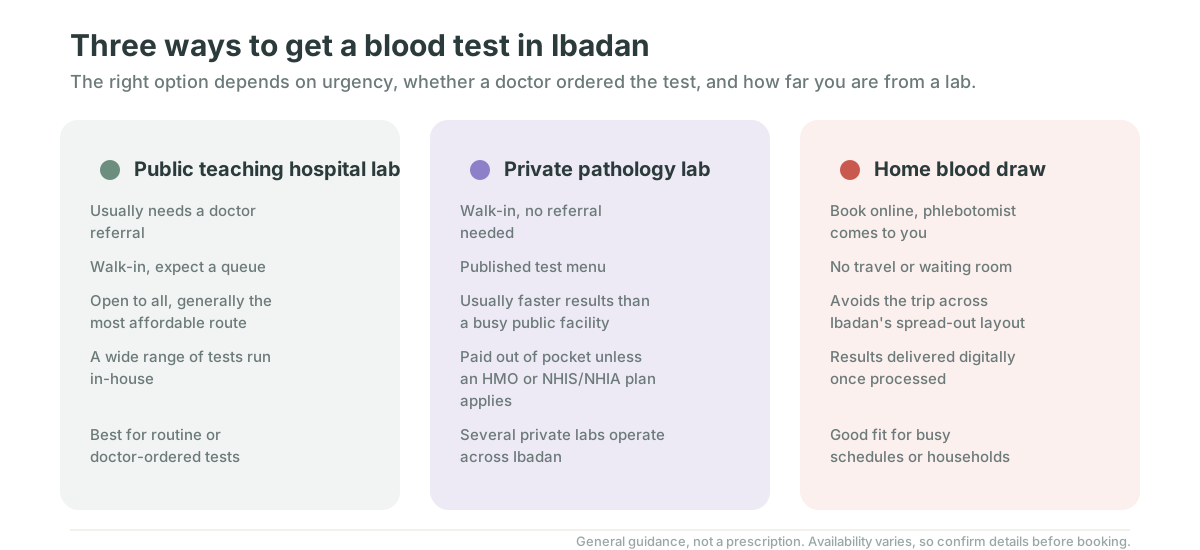
In Ibadan, a blood test can be done at a public teaching hospital laboratory, a private pathology lab, or through a home blood draw service that sends a phlebotomist to you.
All three routes draw the same blood and send it to a laboratory for analysis. What changes is who draws it, where you go, how long you sit and wait, and how much you pay directly versus what an employer, HMO, or NHIS/NHIA enrollment might cover. None of the three wins outright. A test tied to an ongoing condition your doctor is already managing will often run through whichever facility issued the referral, while a routine check you are booking on your own initiative gives you more room to choose.
- Public teaching hospital laboratory: attached to a government hospital, usually needs a referral, open to everyone, generally the most affordable route.
- Private pathology lab: a standalone facility, often faster to get into and out of, with a published menu you can request directly, usually paid out of pocket.
- Home blood draw: a trained phlebotomist visits your home or office, draws the sample there, and the result reaches you once the lab has processed it.
Public hospital laboratories in Ibadan, including the lab at University College Hospital, are typically the most affordable route for a doctor-ordered test, though they usually involve a referral, a queue, and a longer wait for results.
University College Hospital, UCH, is Nigeria's first teaching hospital and remains one of the widely known public facilities in the city, though it is far from the only public option in Ibadan. If a doctor at a government hospital or a public health centre orders a blood test as part of a consultation, the sample is usually drawn on-site and processed by the facility's own laboratory. This route makes the most sense when a doctor has already requested the test as part of your care, rather than when you are booking a screening panel entirely on your own.
Some people ask whether NHIS or NHIA enrollment changes what they pay at a public facility in Ibadan. It can, but coverage depends entirely on your specific scheme and plan, so it is worth asking your provider directly what applies to your test rather than assuming a fixed list. Public facilities also tend to be busy, so budget time for a queue at the draw itself and a wait for some results, particularly at a large teaching hospital that serves patients well beyond the city.
Private pathology labs in Ibadan generally offer a faster turnaround and a more flexible walk-in menu than public facilities, usually paid out of pocket.
Private pathology labs across Ibadan range from small standalone collection points to larger facilities attached to private clinics, and most accept walk-ins alongside booked appointments. Because a private lab isn't processing every sample in the city through one overloaded system, common tests such as a full blood count or a basic metabolic panel often come back sooner. Some also run a broader menu, including tests a smaller public facility may not offer in-house.
The main trade-off is cost. Unless an HMO plan or NHIS/NHIA benefit specifically covers the claim, you pay directly, and prices differ by lab and by panel, so it is worth confirming with the lab before you book rather than guessing. A full blood count remains one of the most frequently ordered tests through this route, since a single sample screens for anaemia, infection, and several other issues at once.
What a full blood count measures, explained in plain language
A home blood draw brings a trained phlebotomist to your home or office in Ibadan, so you can get tested without crossing the city to sit in a lab queue.
This is the model BetterHealth Africa uses. You book a test or a panel online, pick a time, and a trained phlebotomist comes to you wherever you are in the areas the service covers. Ibadan spreads across a wide, hilly area, and getting from one part of the city to a specific lab and back can still take a real chunk of a day once you count the trip both ways, even without a Lagos-style traffic reputation attached to it. A home draw removes that travel and waiting-room portion entirely. The draw itself takes only a few minutes and follows the same safety standard as a lab visit: a fresh sterile kit per client, correct technique, and a sample handled and transported the way any blood sample should be.
A home draw suits people who cannot easily step away from work for a queue, who want several household members tested in one visit, or who would rather not spend an hour in a waiting room for a routine panel. It is not the right choice for an urgent symptom that needs a doctor's assessment alongside the blood draw. If you are unwell and need clinical evaluation, a hospital or clinic visit comes first.
See the full range of tests BetterHealth Africa offers in Ibadan
Most routine blood tests in Ibadan need little preparation, though some, like a fasting blood sugar or a lipid profile, ask you to fast for several hours beforehand.
A general full blood count doesn't require fasting and can be drawn at any time of day. Tests that measure blood sugar or cholesterol are different, since eating or drinking anything besides water changes the reading. If your test requires fasting, plan for roughly 8 to 12 hours without food, which is why an early morning appointment after an overnight fast is the usual approach. Water is normally fine, and prescribed medication should generally continue unless your doctor has told you otherwise. Confirm the specific preparation for your test when you book, since requirements differ by panel.
Turnaround also depends on the test and the route. Some basic tests process the same day, while specialised or send-out tests take longer. Rather than assume a fixed number of hours or days, ask the lab or service directly when you book, since the answer depends on the exact panel and how it is processed.
Tell the phlebotomist about any medication or condition
Mention any medication you take, whether you have a bleeding disorder, or if you have ever fainted or felt unwell during a blood draw. This helps whoever is drawing your blood, in any setting, take the right precautions and get the sample safely on the first try.
Choosing where to get tested in Ibadan comes down to three questions: how urgent the test is, whether a doctor has already ordered it, and how much you want to avoid the trip across town.
There is no single right answer, but working through these questions in order tends to point you toward a route.
- Is this urgent, tied to symptoms, or does it need a doctor's assessment alongside the blood draw? If yes, a hospital or clinic visit comes first, not a standalone test.
- Has a doctor already ordered a specific test as part of your care? If yes, confirm whether it needs to go through a particular facility linked to that referral.
- Is this routine screening you are booking for yourself, with no urgent symptoms? A private lab visit or a home blood draw both work well here.
- Do you have an HMO plan or NHIS/NHIA enrollment, and does it cover the test you need? Check the specific benefit before assuming a route is covered.
- Do you need to test more than one person, such as a household or a group of colleagues? A home blood draw that covers everyone in a single visit is often the most practical choice.
See current BetterHealth Africa pricing for a home blood draw
Routine blood test screening matters in Ibadan because hypertension, type 2 diabetes, malaria, and sickle cell trait all carry a real and well documented burden in Nigeria, and several of these cause no symptoms until damage is already done.
Hypertension and type 2 diabetes are both common across urban and semi-urban Nigeria, and both can develop for years without a single symptom before showing up as a stroke, a heart attack, or kidney damage. A blood test, alongside a blood pressure check, is one of the few practical ways to catch either early enough to act on. Malaria also remains a common cause of fever in and around Ibadan, and a lab test is the reliable way to confirm it rather than guess from symptoms that overlap with other illnesses.
Sickle cell status carries particular weight in Nigeria specifically. Roughly one in four Nigerians carries the sickle cell trait (AS), and Nigeria has more children born with sickle cell disease each year than any other country, a burden tied directly to how widespread the trait is across the population. That is the reason genotype testing has become a standard part of premarital and antenatal screening here, rather than an optional extra reserved for a few families.
Read more: what AA, AS and SS mean, and what genotype compatibility means for a couple
NHIS and NHIA enrollment can factor into what a diagnosed condition costs to manage over time, but coverage varies by scheme and by facility, so it is worth confirming your own plan's specifics with your provider rather than assuming a fixed benefit applies. Whichever route you choose for testing, the underlying point of routine screening stays the same: numbers you track over time, checked before a symptom eventually forces the issue.
Frequently asked questions
Where can you get a blood test done in Ibadan?+
You have three main options in Ibadan: a public teaching hospital laboratory such as the one at University College Hospital, a private pathology lab, or a home blood draw service that sends a phlebotomist to you. Which one fits best depends on whether a doctor has ordered the test, how urgent it is, and how much you want to avoid travelling across the city.
Do you need an appointment for a blood test in Ibadan?+
It depends on the route. Public hospital labs and many private labs accept walk-ins, though you may still queue. A home blood draw is booked in advance, since a phlebotomist needs to schedule the visit. Booking ahead generally means less waiting either way.
Is fasting required before a blood test?+
Not for every test. A general full blood count does not require fasting. Tests that measure blood sugar or cholesterol, such as a fasting blood sugar or a lipid profile, usually ask for roughly 8 to 12 hours without food beforehand, with water normally still allowed. Confirm the specific requirement for your test when you book.
How long does it take to get blood test results in Ibadan?+
Turnaround varies by test and by lab. Some routine tests process the same day, while specialised or send-out tests take longer. Ask the lab or service directly when you book, since this depends on the exact panel and how it is processed.
Is home blood testing available in Ibadan?+
Yes. BetterHealth Africa offers home blood draws in Ibadan, where a trained phlebotomist visits your home or office, draws the sample, and results reach you once the partner laboratory has processed it. This avoids travel and waiting-room time for routine tests.
Does NHIS or NHIA cover blood tests in Ibadan?+
It depends on your specific scheme and plan. Some NHIS or NHIA enrollees have certain laboratory tests covered when ordered through a participating facility, while a routine screening panel booked outside a clinical referral often falls outside what is covered. Check directly with your scheme for the exact test you need rather than assuming a fixed benefit.
This article is general health education, not medical advice. It is not a substitute for diagnosis or treatment by a qualified healthcare professional. Test availability, requirements and coverage can change, so confirm current details with the specific lab, hospital or service before booking, and discuss your results with your doctor.